
Jurimetrics in Power BI: settlement and provision decisions based on history.
How to turn a portfolio's history into a suggested settlement value, success rate and time to resolution, with DAX measures and examples to explore.
What jurimetrics is
Jurimetrics is the use of statistics to understand and predict how court cases behave. In practice, it turns the portfolio's history into objective answers: how much does a settlement usually cost in this type of case? What is the chance of success in this court? How long until the outcome?
In Power BI, jurimetrics stops being a one-off study and becomes an everyday tool: filters by subject, court, phase and opposing party, settlement calculators and alerts, refreshed automatically from the case management system.
Questions jurimetrics answers
- Settlement: what is the usual settlement for this subject and location, and what is an acceptable negotiation range?
- Success: in which phases, courts and types of claim is the success rate higher or lower?
- Time: how long until the outcome, and what does waiting cost compared with settling?
- Provision: what is the expected loss of the portfolio based on history, not only on manual classification?
- Recurring parties: which opposing lawyers and firms appear most often, and with what results?
Techniques used in Power BI
Median and percentiles for the settlement range
The average settlement is distorted by a few very high cases. That is why we use the median as the suggested value and the 25th and 75th percentiles as the negotiation range:
Suggested value =
MEDIANX (
    FILTER ( Settlements, Settlements[Status] = "Closed" ),
    Settlements[Settlement amount]
)

Range P25 =
PERCENTILEX.INC (
    FILTER ( Settlements, Settlements[Status] = "Closed" ),
    Settlements[Settlement amount], 0.25
)

Cases in sample =
CALCULATE ( COUNTROWS ( Settlements ), Settlements[Status] = "Closed" )
Because the measures respect filters, the same calculation answers for any combination of subject, state, court or root cause, and the sample count shows when a slice has too few cases.
Discount and savings
Comparing the settlement amount with the amount claimed and with the average award shows where settling saves money and where it is better to continue the case.
Time to resolution
Time distributions by phase and location show how long cash stays exposed, which feeds into how much it is worth to close the case earlier.
Settlement calculator
With Power BI what-if parameters, the lawyer enters the characteristics of the case and the dashboard returns the suggested value, the range and the history of similar cases.
Live examples (fictitious data)
Dashboard labels are in Portuguese.
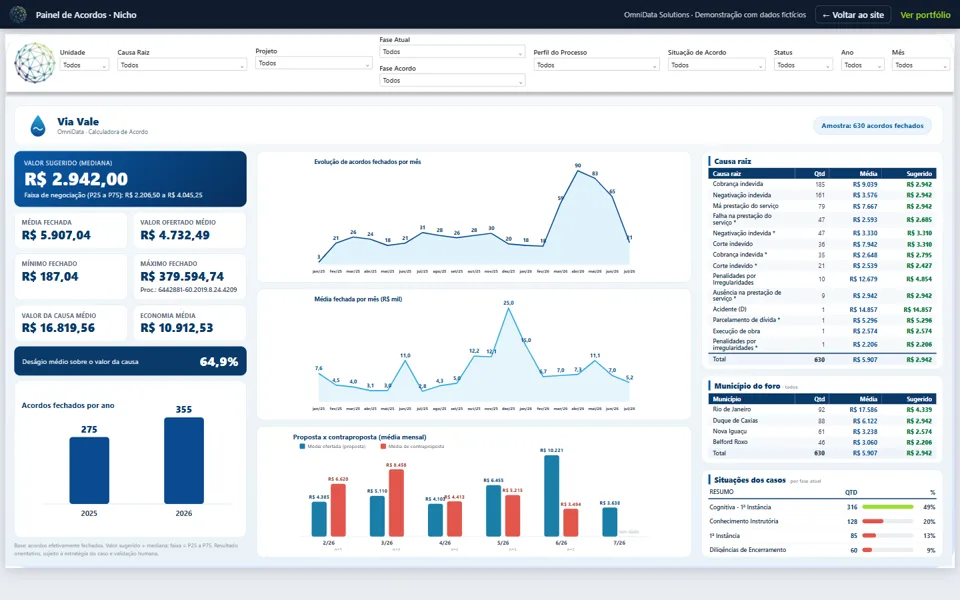 Settlements Dashboard · Niche ↗Suggested value by median, P25–P75 range, average by root cause and by city.
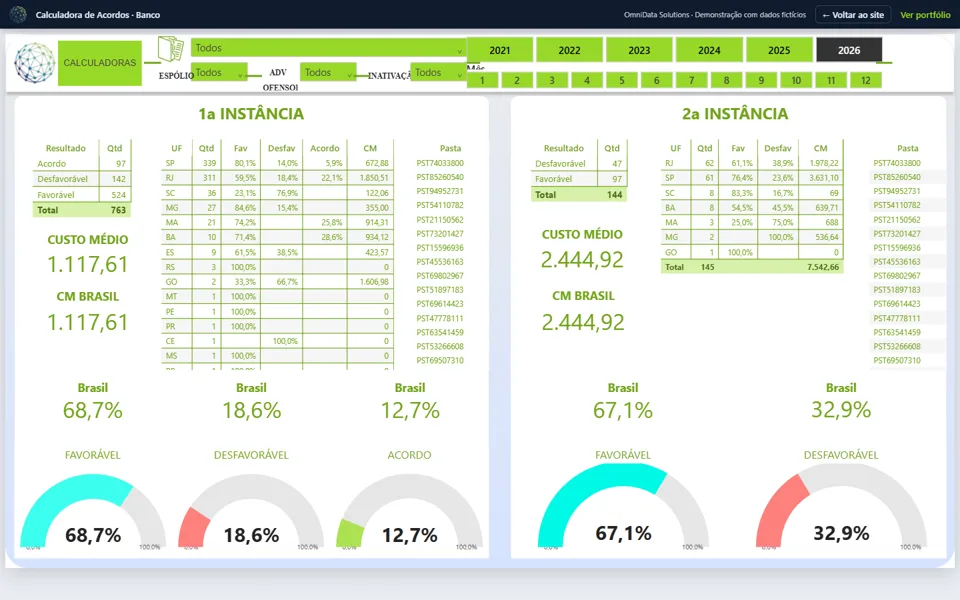 Settlement Calculator · Bank ↗Reference value for negotiation by case profile.
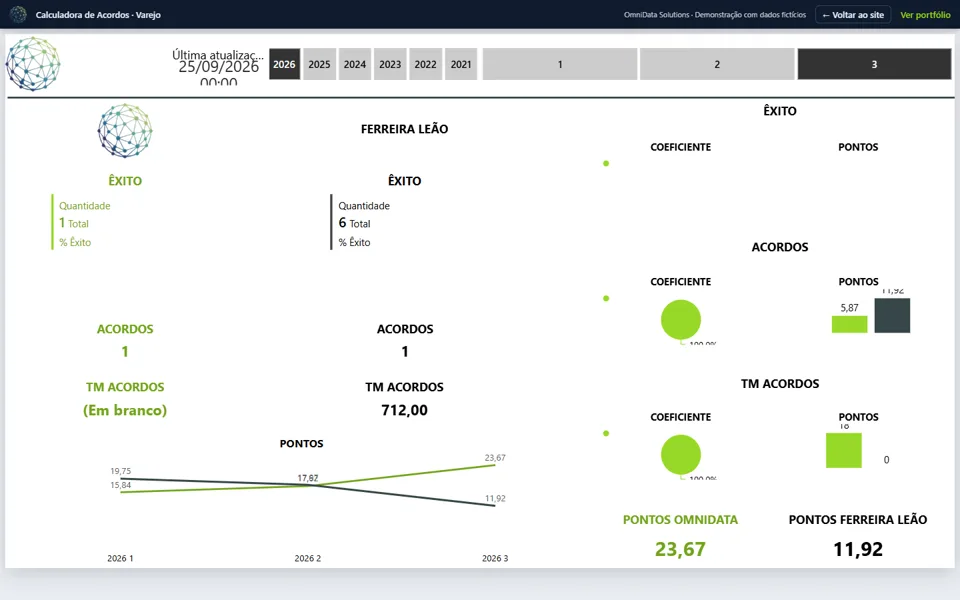 Settlement Calculator · Retail ↗Settlement range and history of similar cases.
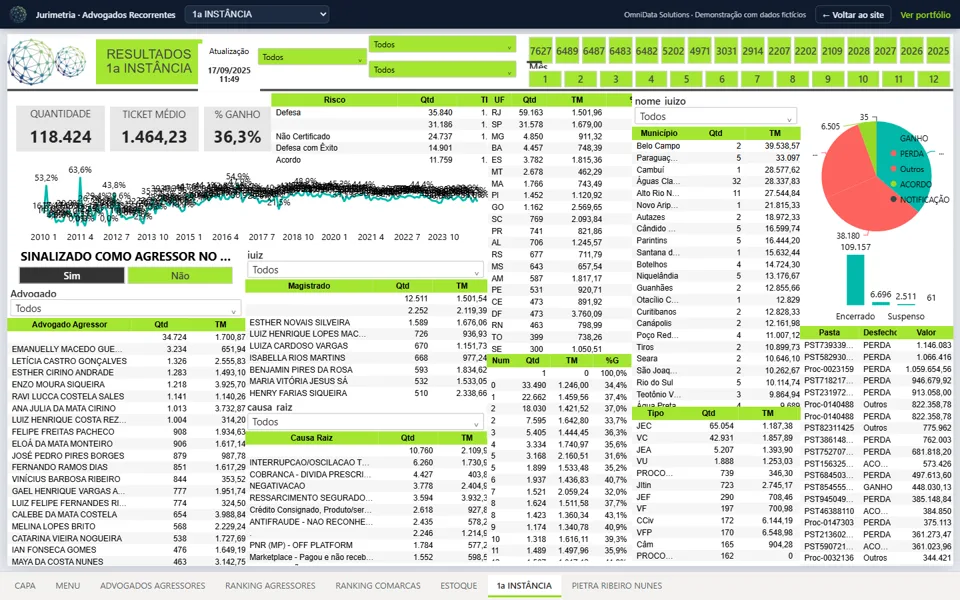 Jurimetrics · Recurring Counsel ↗Results by opposing counsel, court and cause.
What makes jurimetrics reliable
- Clear rules: what counts as success, settlement and closure is defined in writing before any calculation.
- Sample size: slices with few cases are flagged to avoid fragile conclusions.
- Clean data: courts, subjects and party names are standardized before analysis.
- Data protection and confidentiality: least-privilege access, row-level security and a non-disclosure agreement. See how we protect data.
Starting with portfolio monitoring? See the guide on the legal dashboard.
Frequently asked questions
What is jurimetrics?
Jurimetrics is the use of statistics in law: using the history of cases and decisions to measure probabilities, durations and amounts, instead of relying only on each lawyer's perception.
Can jurimetrics be done in Power BI?
Yes. With a well-structured data model, DAX measures such as median and percentiles, what-if parameters and row-level security, Power BI delivers interactive jurimetrics for the whole team.
What is the minimum number of cases?
It depends on the slice. For a reliable estimate, each group analyzed (for example, subject and court) needs dozens of closed cases. The dashboard shows the sample size next to each KPI to avoid conclusions drawn from too few cases.
Does jurimetrics replace the lawyer's judgment?
No. It provides an objective reference, such as the usual settlement range for that type of case, and the lawyer decides considering the specifics of the case.
Can public court data be used?
Yes, as long as the terms of use of the sources and data protection law are respected. In most projects, however, the most valuable base is the portfolio's own history.
Shall we talk about your data?
The initial assessment is free and with no commitment. We can sign a non-disclosure agreement before seeing any information.