
Legal dashboard: deadlines, portfolio, settlements and outcomes in one place.
Which KPIs to track, where the data comes from and what a real legal dashboard looks like, with examples you can open and explore.
What a legal dashboard is
A legal dashboard puts on one screen the numbers a legal team follows every day: case portfolio, deadlines, hearings, settlements, outcomes, provisions and team productivity. Instead of reports assembled by hand from spreadsheets and case-system exports, the KPIs refresh automatically and follow the same calculation rule for every team.
It serves both in-house legal departments, which report risk and provisions to the board, and law firms, especially high-volume litigation practices that report to many clients and control thousands of deadlines.
Essential KPIs
| KPI | Question it answers |
|---|---|
| Open, new and closed cases | Is the portfolio growing or shrinking? For which clients, subjects and regions? |
| Overdue, due-today and upcoming deadlines | What must be done today, and by whom? Where is there a risk of missing a deadline? |
| Success rate and outcomes | How much do we win, lose and settle, by phase, court and type of claim? |
| Settlements: value, discount and savings | How much are we paying compared with the claim and with history? Where does settling pay off? |
| Time to resolution | How long does a case take to close, by phase and location? |
| Provision and risk | What is the probable, possible and remote exposure, and how did it change this month? |
| Productivity | How many filings, hearings and tasks each team delivers, and with what quality? |
Live examples (fictitious data)
These portfolio dashboards are versions of delivered legal projects, rebuilt with fictitious data. Their labels are in Portuguese; open, filter and explore:
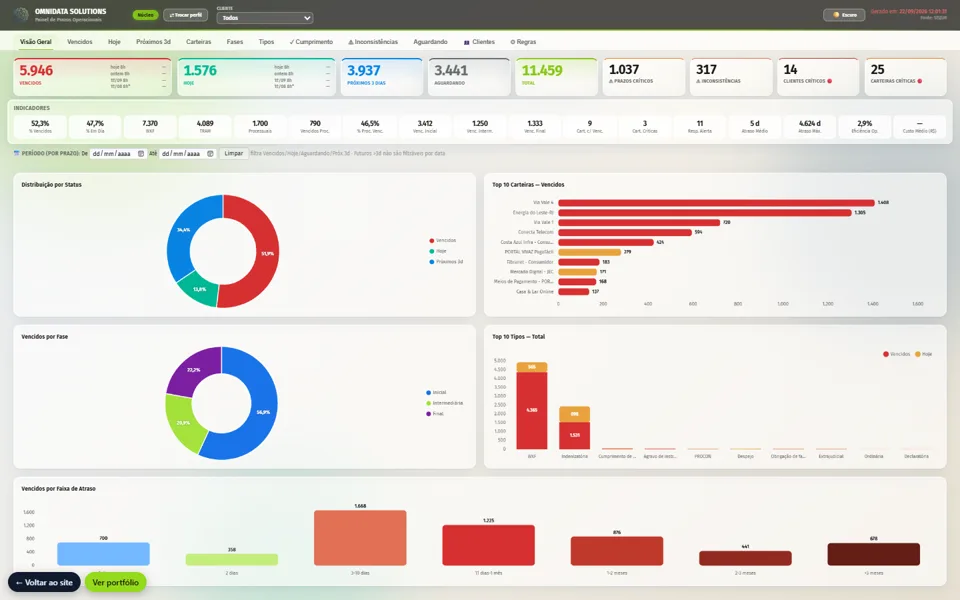 Deadlines Dashboard ↗Overdue, due-today and upcoming deadlines by role, with inconsistencies and compliance. 10 pages.
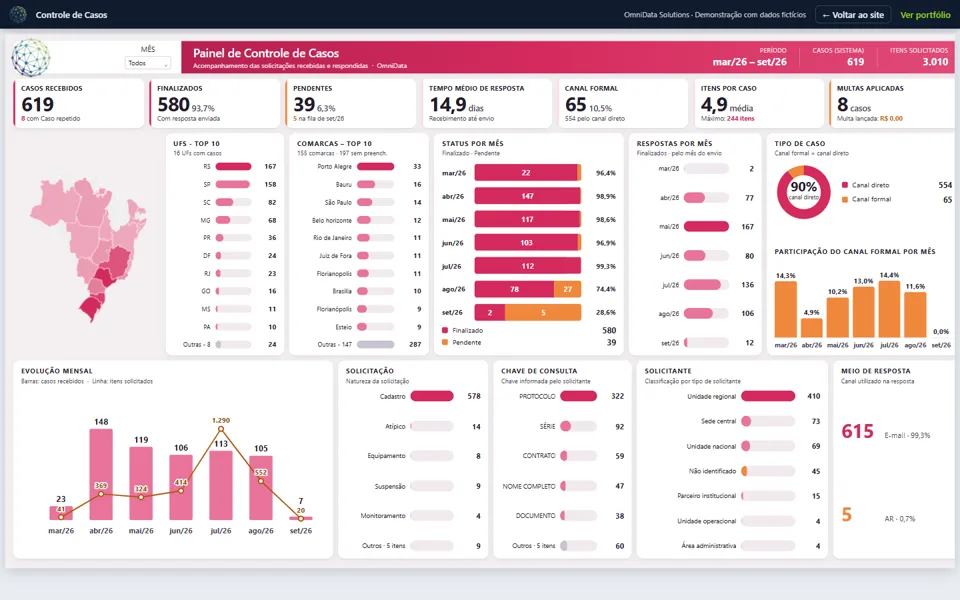 Case Control ↗Received, closed and pending cases, response time and a map by state.
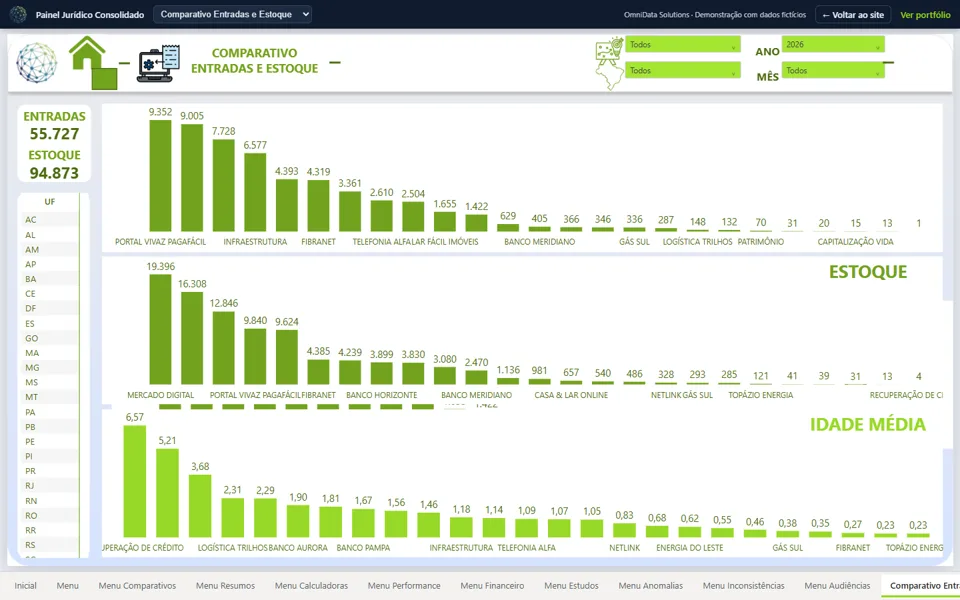 Consolidated Legal Dashboard ↗New cases, open cases and average age by client and by state.
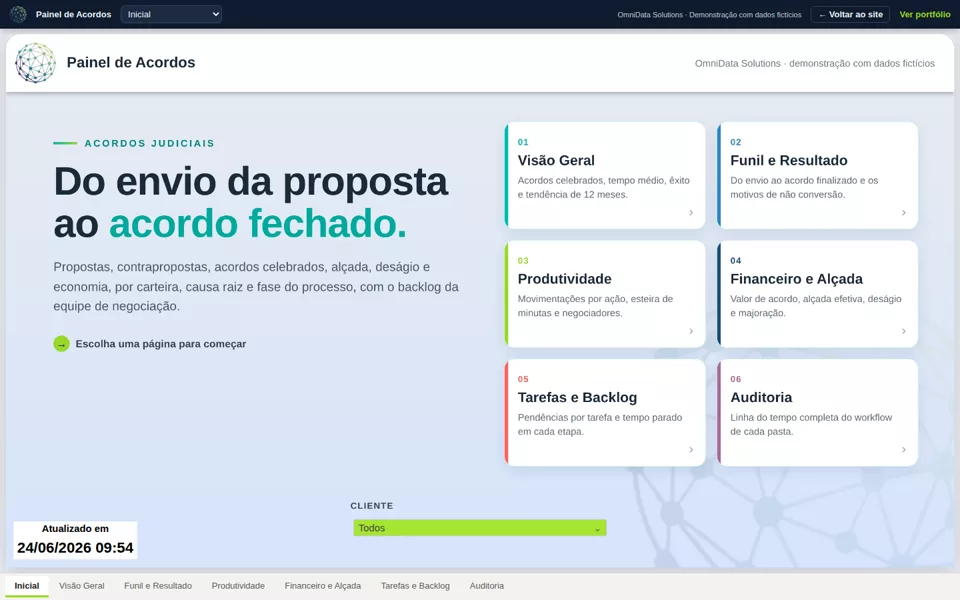 Settlements Dashboard ↗Offers, closed settlements, savings and discount by root cause. 7 pages.
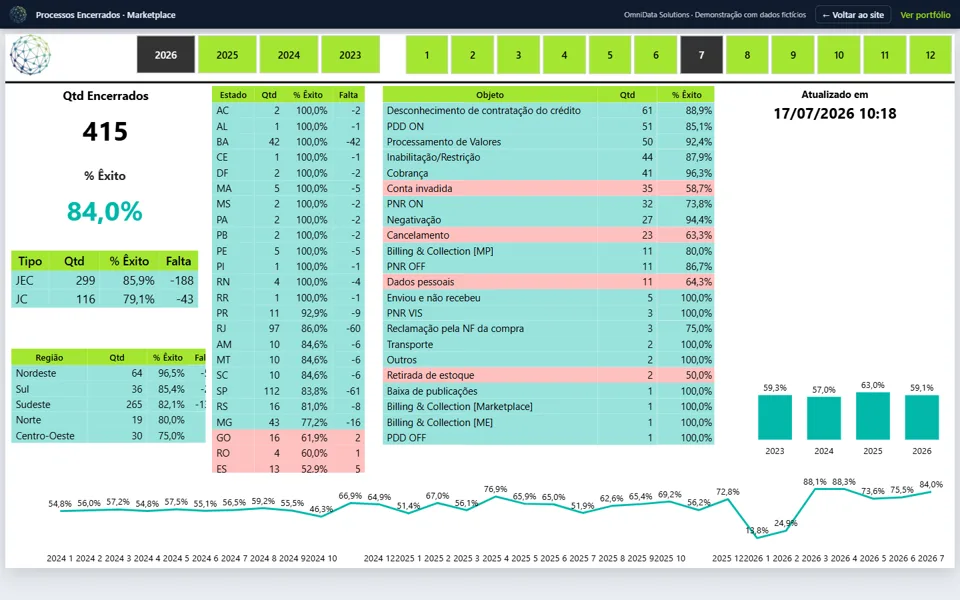 Closed Cases ↗Outcomes, amounts and time to closure of a marketplace portfolio.
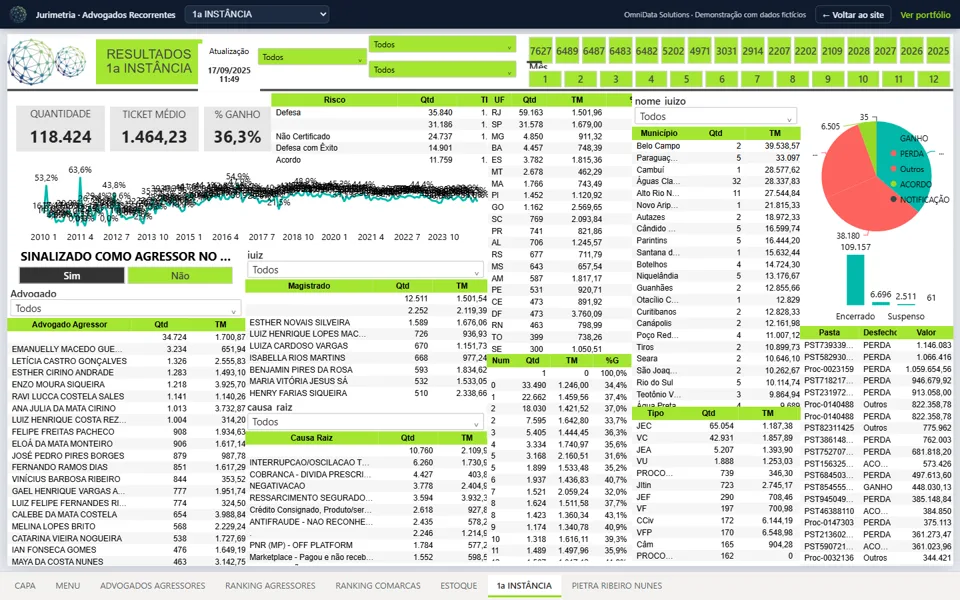 Jurimetrics · Recurring Counsel ↗Results by opposing counsel, court and cause.
Where the data comes from
- The case management system of the firm or department, through scheduled exports, database access or API;
- spreadsheets that control deadlines, settlements, provisions and fees;
- ERP and finance, for payments, court costs and fees;
- client data (for law firms), for reports per portfolio.
We sign a non-disclosure agreement before any access, and apply row-level security so each client, partner or team sees only their own portfolio. See how we protect data.
How we build it
- Assessment: which decisions the dashboard must support and which sources exist.
- Business rules in writing: what counts as closed, how the discount is calculated, which date drives each deadline.
- Prototype with KPIs and navigation approved by you.
- Build, testing and training, with documented sources and measures.
- Evolution: new KPIs as the operation changes.
Want to go beyond monitoring and use history to decide on settlements and provisions? Read the guide on jurimetrics in Power BI.
Frequently asked questions
What is a legal dashboard?
A single screen that brings together the key numbers of a legal department or law firm: case portfolio, deadlines, hearings, settlements, outcomes, provisions and team productivity, refreshed automatically from the case management system and spreadsheets.
Which KPIs should a legal dashboard track?
The most common are: open cases, new and closed cases, overdue and due-today deadlines, success rate, settlement value and discount, average time to resolution, provision and risk by phase, and productivity per owner.
Can it connect to the legal software we already use?
In most cases, yes: through scheduled exports, database access or the API of the case management system. During the assessment we choose the safest way to extract the data.
Power BI or a web dashboard for legal teams?
Power BI fits companies already on Microsoft 365 that want to explore the data. A web dashboard is ideal for sharing with a law firm's clients or many users without a per-user license.
How much does a legal dashboard cost?
A focused dashboard starts at R$ 1,900 (Essential Dashboard) and a multi-source, multi-page dashboard at R$ 3,900 (Professional Dashboard). The final price is set in writing after the assessment.
Shall we talk about your data?
The initial assessment is free and with no commitment. We can sign a non-disclosure agreement before seeing any information.